Public transport (and a little about private car use)
One of the first things I had to familiarise myself with in Oslo was the public transport system.
 i
iPublic transport in Oslo seems to run extremely smoothly.
There is a very extensive network consisting of the T-bane (Tunnelbane/Metro), buses and trams, which they call ‘light rail’ up here. In addition, there are a number of ferries criss-crossing the Oslo Fjord; for example, there’s a direct ferry between my workplace in Fornbu and Aker Brygge. These elements are collectively known as Ruter#.
Furthermore, the Norwegian State Railways (NSB) form part of the integrated system, and you can use travel tickets across the network to a certain extent, although I’m not yet 100 per cent familiar with the details.
Unlike all Danish public transport, which is often cumbersome and at times downright customer-unfriendly, Oslo’s transport system seems as though it has been designed to serve a practical purpose.
Oslo has its own version of the Rejsekort, which I don’t yet know how to get hold of, but there are also a number of alternatives that seem somewhat simpler for a tourist or anyone else who can figure out how to use an electronic device.
Firstly, you can buy single tickets and 24-hour tickets in lots of places. These are shaped like a Rejsekort (though they’re made of paper) and must be used as such at the start of your journey; that is, you swipe them at the card readers located at the entrance to the ticket zones in the metro or inside the door of a bus or tram. It’s possible to buy a stack in advance, but then you have to remember which ones you’ve already swiped, and you mustn’t swipe the whole stack at once...
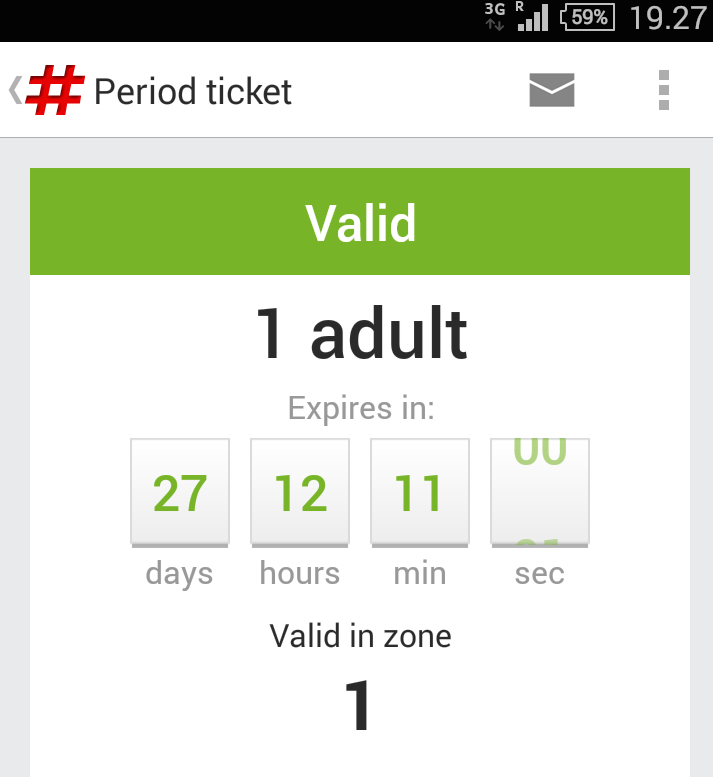
However, you very rarely see anyone swiping anything anywhere, and this is probably because Ruter# has created an app called Ruterbillet, which is a far better alternative.
It took me about 2 minutes to download the app and enter my card details (I’m also looking forward to seeing if they’ve designed a card-swapping process as user-friendly as the Danish Rejsekort. Perhaps something along the lines of a code you can only see if you get enough lift on a flight from Holmenkollen).
After that, it was simply a matter of choosing a single ticket or a season ticket. Select the number of zones and the number of days, then press ‘Confirm’.
So now I have a valid travel pass for most of Oslo for the rest of February, provided I can keep my mobile charged in this cold weather.
Incidentally, the zone system is another sign that transport has been prioritised over administration up here. Zone 1 covers the entire metro network and a very large part of the area surrounding Oslo. The entire capital region (Oslo and Akershus) has a total of 8 zones. In Copenhagen, you’d barely make it past Valby Bakke before you’d counted up to 8 zones.
A one-month pass for unlimited travel within Zone 1 costs 680 NOK.
Zone 1 extends a good distance beyond the Bomringen, which is the toll ring surrounding Oslo. It costs 46 kroner to drive into Oslo (there are two tiers). As I write this, I’m a bit unsure whether you pay to drive both in and out, but regardless, it costs less per working day to take public transport than it does to drive your car into a flat in the city centre.
On top of that, there’s the cost of the car itself, and parking in the city centre, which costs around 1,600–2,000 a month depending on the neighbourhood. I reckon I’ll probably need a car at some point, but whether it’ll be an everyday car or a weekend car parked outside the ‘ring road’ remains to be seen.